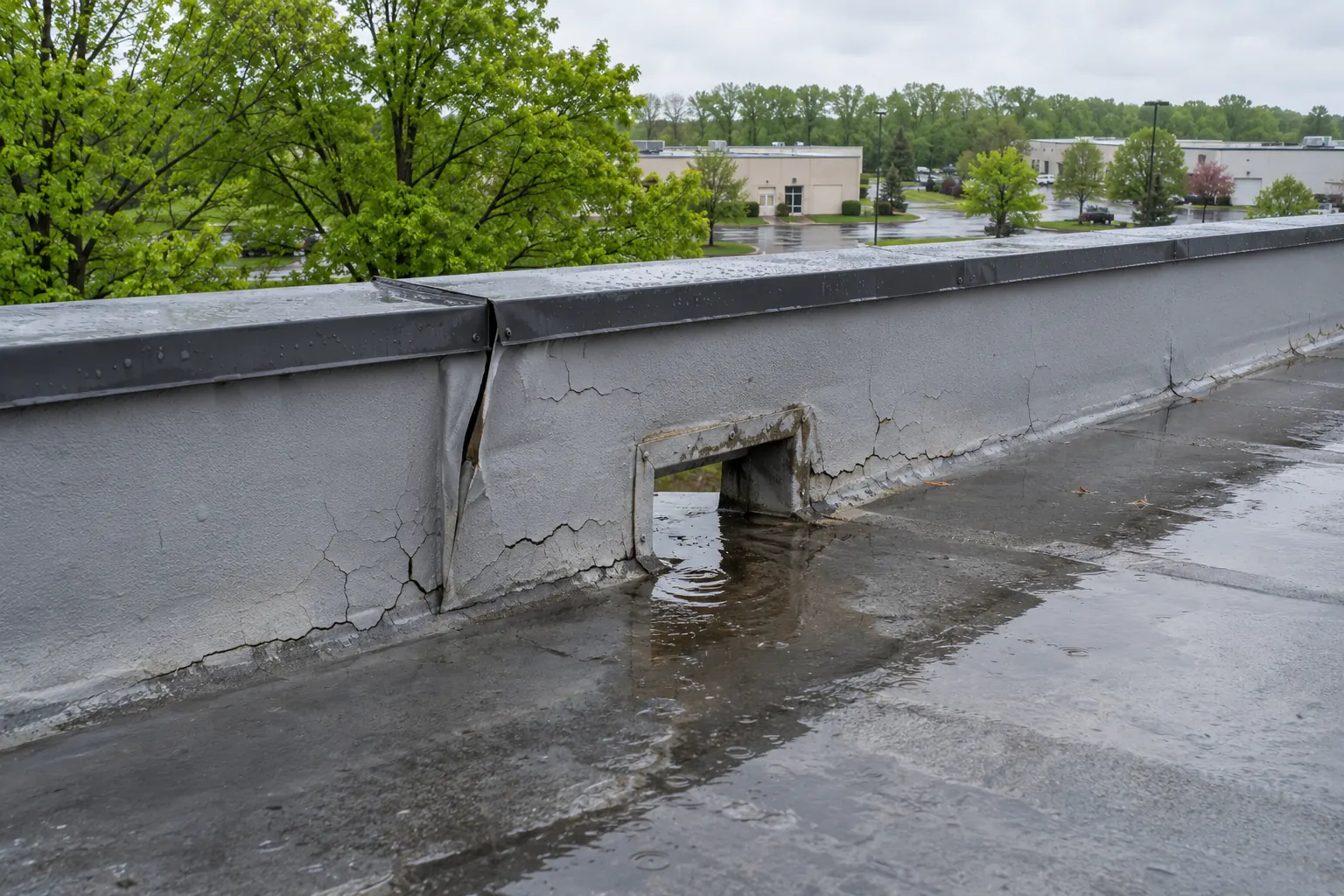
Base Flashing
Cracked Base Flashing
Flashing where the membrane turns up the parapet hardens and cracks with age. Water slips behind it during heavy rain and runs down the inside face of the wall.

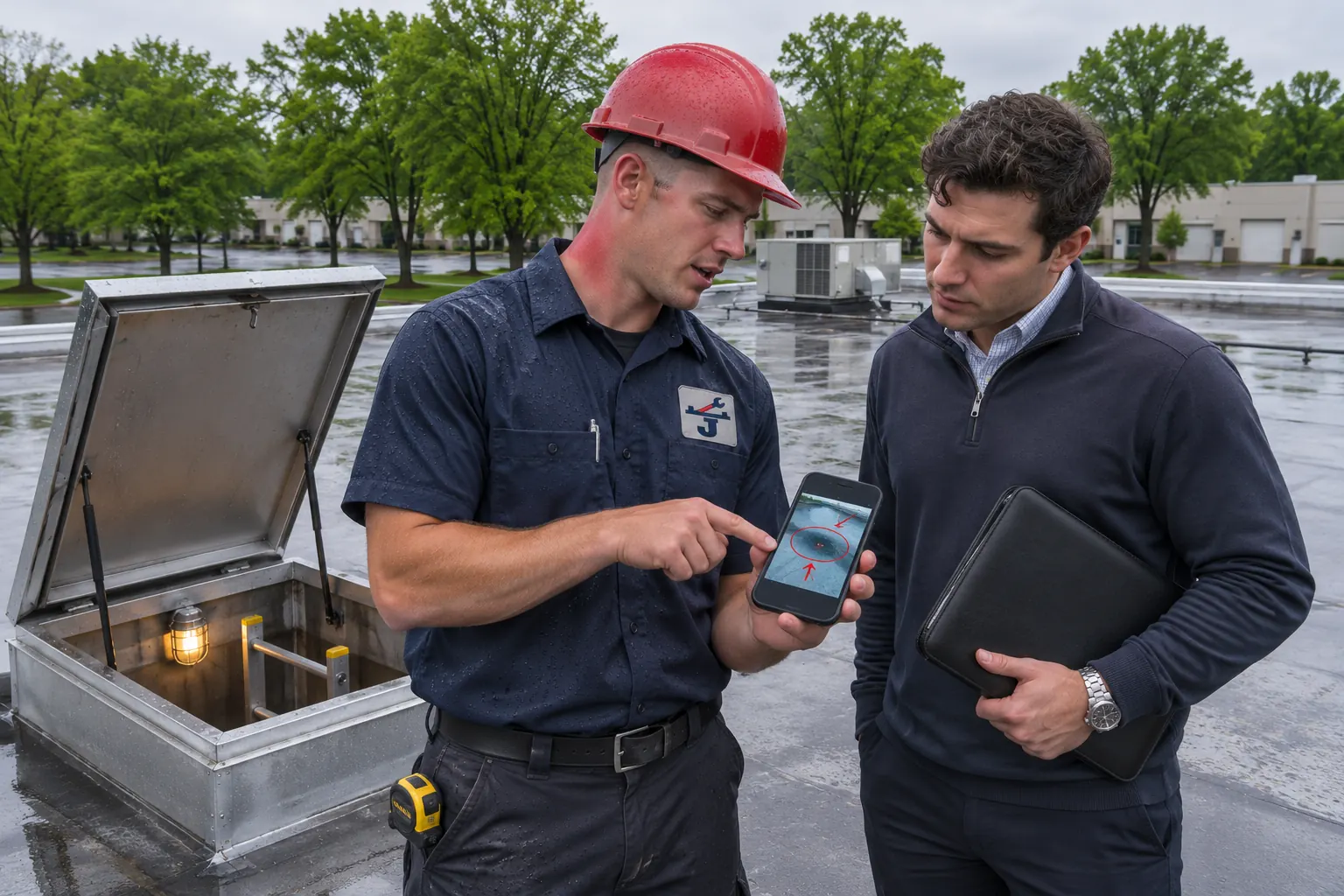
We handle Graymoor-Devondale commercial roof repair on office and church roofs, sealing cracked base flashing and dried-out through-wall scuppers along parapet walls.
Graymoor-Devondale commercial roof repair centers on the walls around the roof. Offices and churches here often have low-slope roofs edged by parapets, and water collects where the membrane turns up those walls.
Through-wall scuppers drain these roofs by passing straight through the parapet. When the sealant around a scupper box dries out, water runs into the wall cavity instead of out to the downspout.
Most leaks on these roofs start within a few feet of a wall. Four spots along those walls get a close look on every visit.
Flashing where the membrane turns up the parapet hardens and cracks with age. Water slips behind it during heavy rain and runs down the inside face of the wall.
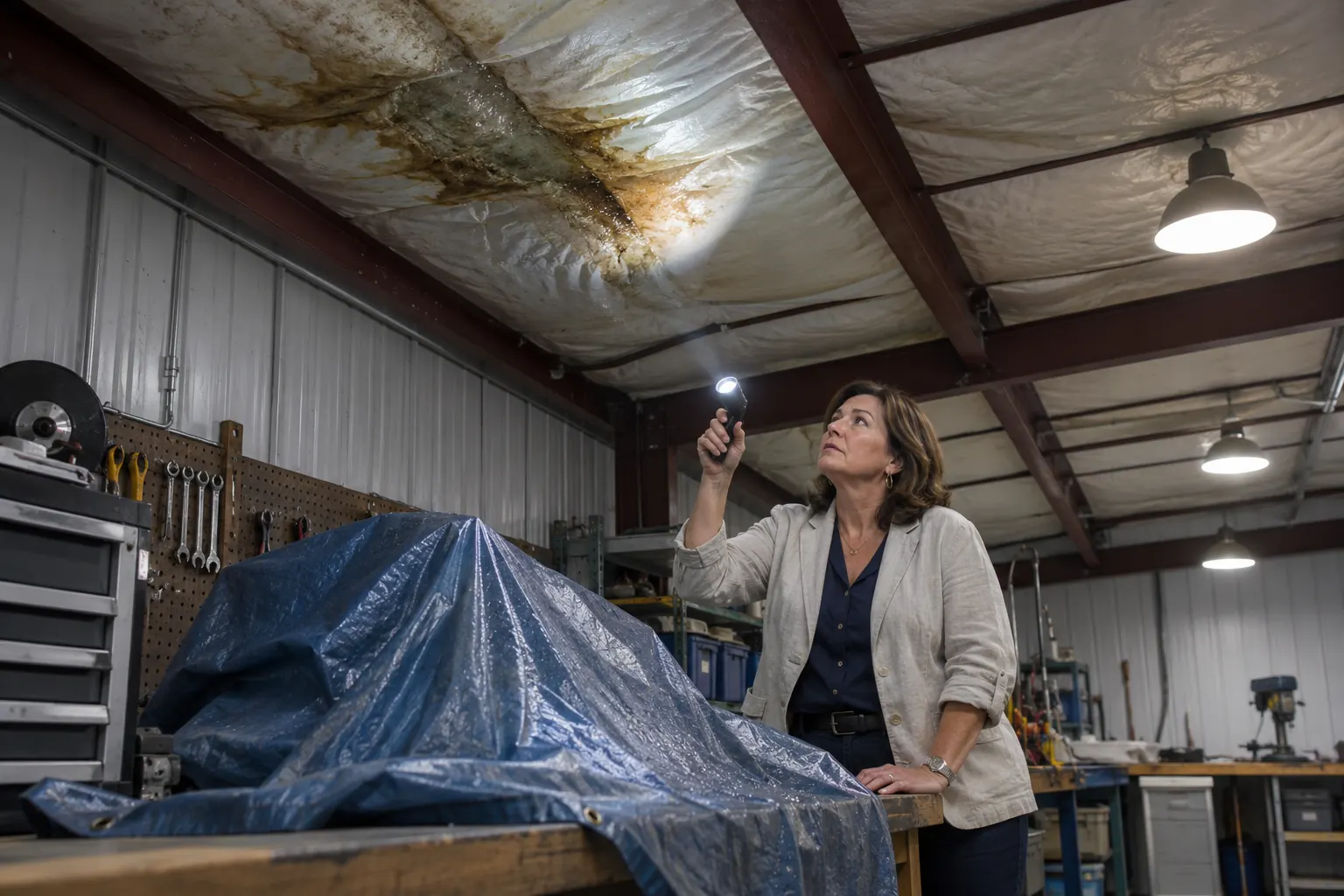
Through-wall scupper boxes rely on a sealant bead where metal meets membrane. Once that bead shrinks, standing water at the outlet feeds straight into the wall cavity.
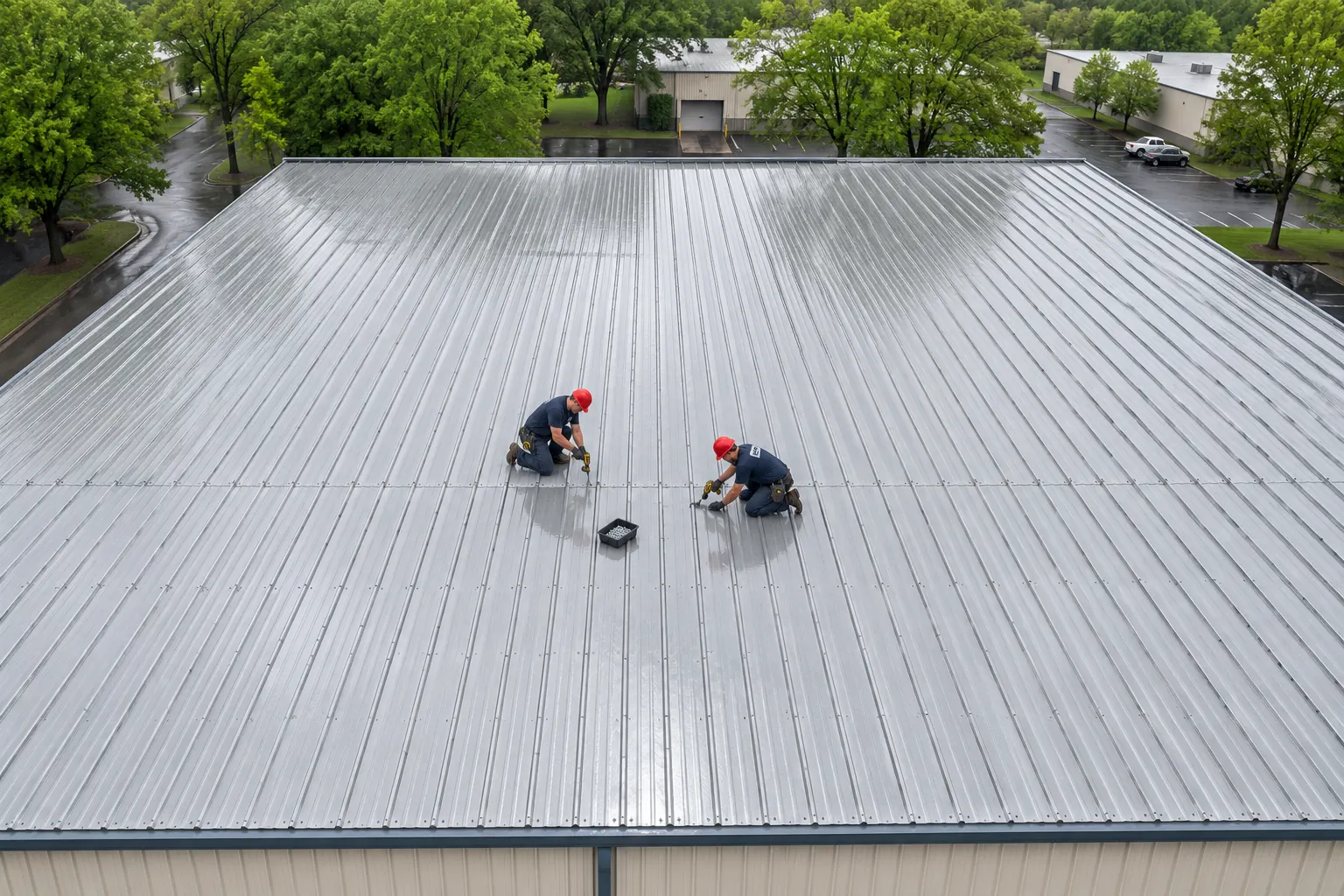
Metal counterflashing tucked into a reglet in the brick shields the top edge of the base flashing. When its sealant lets go, wind-driven rain gets behind both layers.
Debris or a sagging deck keeps water from reaching the scupper. Ponds against the parapet keep the base flashing wet for days and wear the nearby seams faster.
Repairs at the parapet protect more than the roof. These are the gains a sealed wall line brings to an office or church.
Sealed base flashing keeps water out of the parapet, protecting brick mortar and the framing behind interior finishes.
Clear, resealed scuppers move water off the roof after each storm, so it stops standing against the wall.
Plaster, paint, and ceiling tiles in sanctuaries and offices stay unstained once the leak at the wall line is closed.
Boards along the parapet edge stay dry, keeping future cutouts small when a flashing seam needs attention.
Dated photos of each scupper and flashing run give a church board or office owner a clear record of the work.
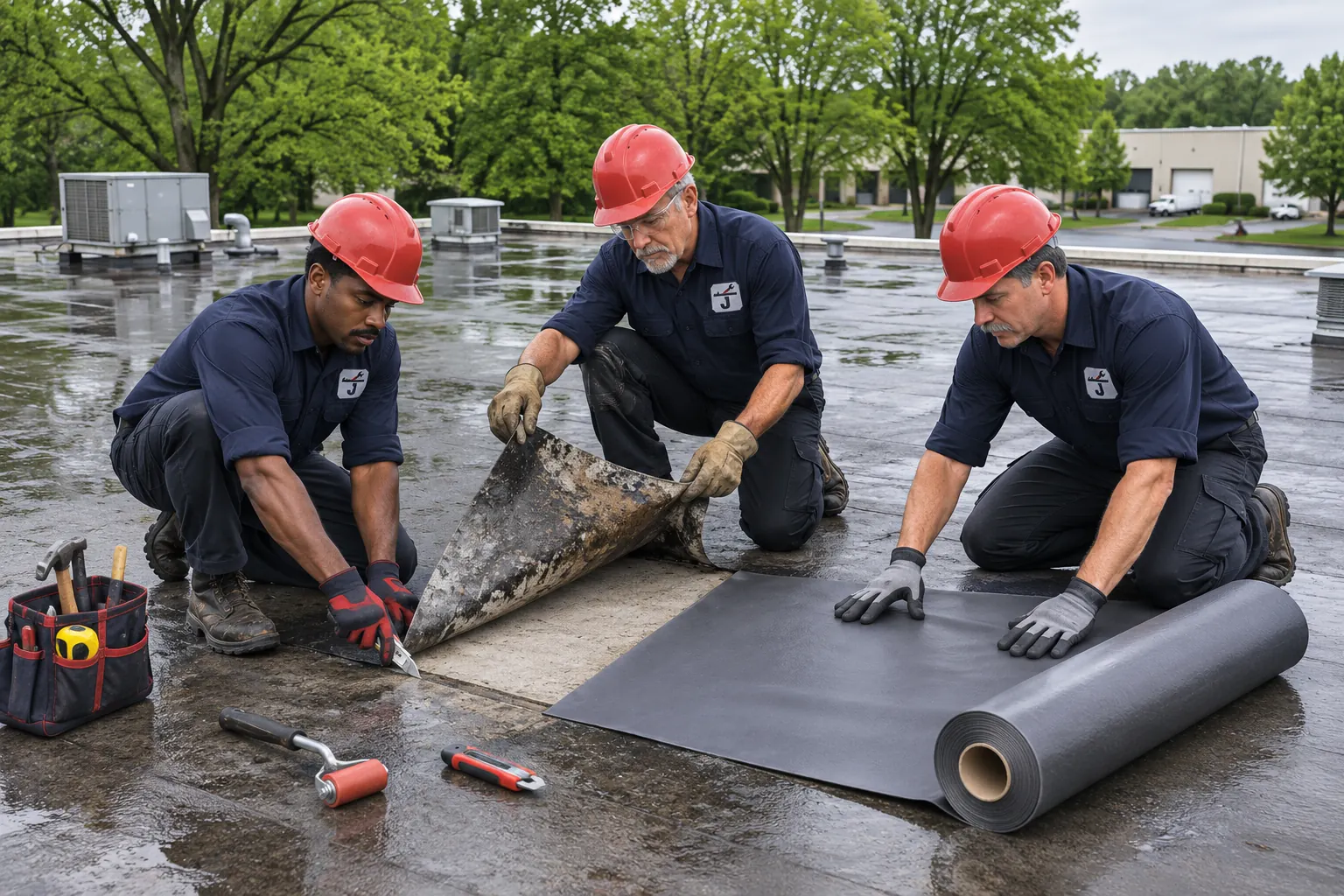
Three services cover the parapet and scupper work on these buildings. Follow a link for the details of each.
Rebuilt base flashing, welded or taped membrane patches, and resealed scupper boxes on the low-slope roofs behind office and church parapets.
Flat roof flashing and patch repairTracing a stain on a sanctuary ceiling or office wall back to the scupper, coping joint, or counterflashing reglet that let the water in.
Leak tracing on parapet roofsResealing coping caps and counterflashing, plus fastener, end-lap, and panel work on metal roof sections and entry canopies.
Metal coping and roof repairCall and tell us which wall the water sits against and where stains show inside. That points the roofer to the scupper box or flashing run first.
Work shifts between the roof, the wall line, and the rooms below. Each step is marked where it takes place.
A roofer walks each parapet run, probes the base flashing, checks every scupper box and coping joint, and photographs the defects nearest the stains reported inside.
Graymoor-Devondale is a home-rule city that has posted its own building permit form. We ask for the current form and whether Louisville Metro also needs to issue a permit for the flashing work.
Leaves and silt come out of the scupper box and the ponded area in front of it, so the membrane and wall flashing dry fully before any sealant goes on.
Cracked base flashing is cut back, new membrane flashing goes up the wall under the counterflashing, and the scupper box gets a fresh sealant bead tied into the patch.
After the next rain, the office or sanctuary ceiling under each repaired wall is checked for new stains, and the results go to the owner with photos of the flashing.
Own a building in a neighboring city? Call us or send us a message and we will confirm coverage. We also repair commercial roofs in the towns below.
Answers on parapet roofs, scuppers, and permits for Graymoor-Devondale offices and churches.
Start with Graymoor-Devondale City Hall. As a home-rule city, it has posted its own building permit form in past years, so ask for the current version and whether Louisville Metro must also issue a permit. Office and church roofs there are often low-slope behind parapets, and wall leaks tend to begin at cracked base flashing or dried scupper sealant.
A stain near an outside wall usually traces back to the parapet above it. Water that slips past cracked base flashing or a loose counterflashing reglet runs down inside the wall and spreads across the ceiling at its edge. We check the wall line and scupper above before looking anywhere else on the roof.
Clear them each spring and fall, and after any storm that drops branches or leaves on the roof. On many parapet roofs the scupper is the only outlet, so a blocked box sends water up against the base flashing. A stain on the outside wall below the box points to a failing seal.
It can. An undersized scupper can be cut wider, or a second one added in a low area. That work opens the parapet wall, so ask city hall about it before ordering parts. Tapered insulation crickets can also steer water toward the existing outlet with the wall left as it is.
Standing water and movement are the main causes. The roof deck and the parapet wall shift differently through heat and cold, which strains the seam where membrane meets wall. Ponding in that corner keeps the lap wet, so seams there wear out before seams in the open field of the roof.
Most of the work fits around them. Flashing and scupper repairs happen from the roof surface, and louder steps like cutting out wet insulation can be set for weekday mornings or other quiet times. Share the service schedule and any events, and the roof work is planned around them. Rooms under any cut area are covered first.
Send the address and the wall where water shows inside. We will check the flashing and scuppers on that side first.
Leave a name and number and we will call you about the leak, seam, or panel you are dealing with.
Or call now: (502) 323-6989