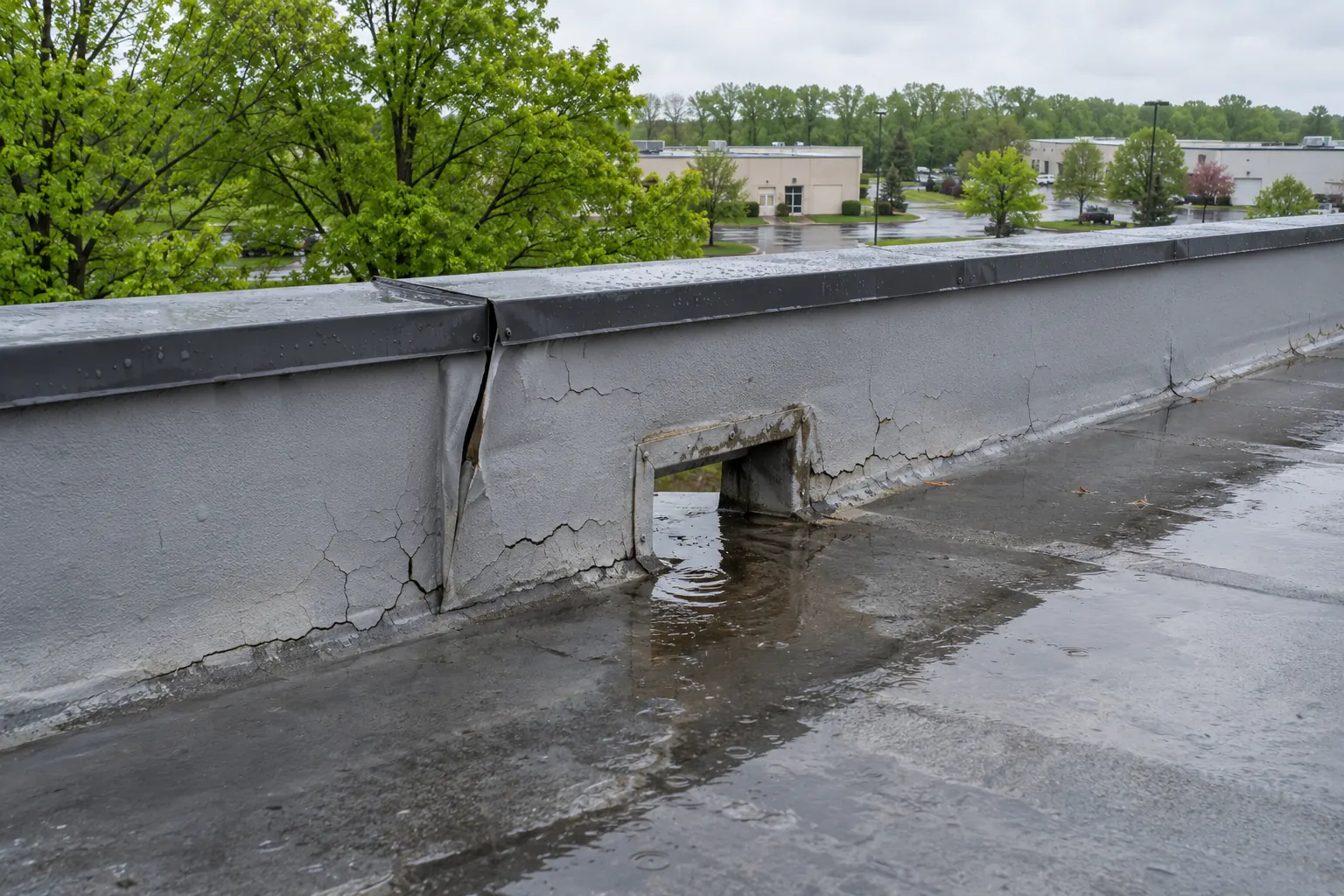
Close view of a worn commercial roof surface with damaged areas
FAQ

Commercial Roof Repair Questions in Jeffersontown

Plain Answers on Leaks, Seams, Panels, Permits, and Cost

Here are our answers to common commercial roof repair questions in Jeffersontown, grouped by roof type, weather and permits, cost, and town.

Jump to the commercial roof repair questions in Jeffersontown that match your roof:

Commercial roof repair is the work of finding and fixing leaks, seam failures, flashing breaks and storm damage on existing commercial roofs. Jeffersontown Commercial Roof Repair fixes flat, metal and industrial roofs on commercial, industrial and agricultural buildings across Jeffersontown and the rest of Jefferson County, Kentucky, plus surrounding towns reaching from Fern Creek out to La Grange.

Basic Commercial Roof Repair Questions in Jeffersontown

What problems does commercial roof repair fix?

Commercial roof repair fixes the specific spots where water gets in or where the roof surface has started to fail. Most repair calls trace back to a short list of problems on the roof itself.

  • Open or peeling seams on membrane roofs
  • Punctures from dropped tools, hail or foot traffic
  • Cracked flashing at curbs, walls, pipes and skylights
  • Backed-out fasteners and rusted panels on metal roofs
  • Clogged or broken drains, scuppers and gutters
  • Blisters and splits in older built-up or modified bitumen roofs

Each repair starts by confirming the source. Water inside a building often travels along the deck or a purlin before it drips, so the stain on the ceiling rarely sits directly under the opening.

How is the choice made between repairing, restoring and replacing a Jeffersontown roof?

The amount of intact material left on the roof decides between repair, restoration and replacement. Isolated damage on a solid roof calls for repair, while widespread wear on dry insulation points to restoration, and wet insulation across large areas points to replacement.

Roof conditionRepairRestoreReplace
A few open seams or one leaking curbYes
Aging surface, dry insulation, many small cracksYes
Wet insulation in scattered spotsYes, with cutoutsPossible after cutouts
Wet insulation over much of the roofYes
Rusted-through deck or panels in many baysYes

A roof walk with moisture readings shows which column a building falls in.

Does a temporary roof patch hold until a permanent repair can be made?

A temporary repair stops water for a short time until conditions allow the real fix, while a permanent repair uses materials that match the roof system and are installed on a clean, dry surface.

FeatureTemporary repairPermanent repair
When it happensDuring or right after rainOn a dry day with proper prep
MaterialsRoof cement, tape, tarpsMatching membrane, weld or tape patches, new flashing
Surface prepMinimalCleaned, primed and dried
Expected roleHolds until the next visitBecomes part of the roof

Temporary patches often trap moisture or bond poorly to the sheet, so each one gets removed and replaced with a matching repair once the roof dries.

Flat Roof Repair Questions

What damage shows up most often on flat commercial roofs?

Flat commercial roofs show seam failures, punctures and flashing breaks more than any other damage, because water sits longer on a low-slope surface and finds small openings. Around Jeffersontown, those roofs are mostly TPO, EPDM, built-up and modified bitumen.

Signs to watch for during a roof walk:

  • Lap edges lifting at seams
  • Cuts and holes near rooftop units where service crews work
  • Cracked base flashing at parapet walls
  • Ponding water that stays two days after rain
  • Bubbles or soft spots underfoot

Each sign marks a place where water either has entered or soon will. Catching them during dry weather lets the repair go in properly.

How are flat roof membranes repaired?

Matching patches repair flat roof membranes, made from the same family of material as the roof and attached by the method that system uses. A TPO roof takes a welded TPO patch, and an EPDM roof takes a taped EPDM patch.

Roof systemRepair methodKey prep step
TPOHot-air welded patchClean and wipe the weathered sheet before welding
EPDMPrimer and seam tape or cured cover stripScrub and prime the rubber
PVCHot-air welded PVC patchClean off dirt and plasticizer film
Modified bitumenTorched or cold-applied cap sheet patchRemove loose granules
Built-upLayered felts and bitumenScrape gravel back to the plies

Mixing materials, such as roof cement on TPO, rarely bonds for long.

How is ponding water fixed on a flat roof?

Ponding water is fixed by giving it a path to a drain, either by clearing what blocks the path or by building slope where the roof sags. The first check is always the drains themselves.

Common fixes for ponding:

  • Clearing leaves and debris from drain strainers and scuppers
  • Resetting a drain bowl that sits higher than the roof around it
  • Adding tapered insulation crickets between drains
  • Installing an added drain or scupper in a low area
  • Repairing deck sag under the low spot

Water that stands on a membrane for days speeds up wear at seams and adds weight to the deck. Patches inside a ponding area get extra attention because they stay wet the longest.

Should blisters on a flat roof be cut open?

Small, firm blisters on a built-up or modified bitumen roof are often left alone and watched, while large, soft or cracked blisters get cut, dried and patched. A blister is a pocket of trapped air or moisture between layers.

Repair steps for a damaged blister:

  • Cut an X through the blister surface
  • Let the layers underneath dry out
  • Press the flaps down in fresh bitumen
  • Cover the area with a patch larger than the cut

Many blisters on one section point to moisture inside the roof, and a moisture survey then shows whether the insulation is wet.

How are punctures around rooftop units repaired?

Punctures around rooftop units are repaired with a patch matched to the membrane, extended well past the damage on every side, and then protected with walkway pads. Most of these holes come from dropped screws, tools and panels during HVAC service.

A careful puncture repair includes:

  • Probing around the hole for wet insulation underneath
  • Cutting out and replacing any wet boards
  • Rounding patch corners so edges resist peeling
  • Setting walkway pads along the service route

Where one unit shows several old patches, a pad route to that unit prevents the next round of damage.

Related: Flat roof repair in Jeffersontown

Commercial Metal Roof Repair Questions

Why do commercial metal roofs leak?

Commercial metal roofs leak mostly at fasteners, end laps and flashings, where water can slip past a joint instead of running off the panel. Exposed-fastener R-panel roofs on shops, warehouses and farm buildings show these problems most.

Leak pointWhat fails
Screw headsRubber washers crack or screws back out
End lapsSealant dries out where panels overlap
Ridge capsClosures shrink or fasteners loosen
Skylight panelsFiberglass panels crack or yellow
GuttersSeams split and hangers bend
Curbs and pipesFlashings separate from the panel ribs

Daily heating and cooling moves the panels, and that movement works joints loose over time.

How are backed-out or loose fasteners repaired on a metal roof?

Loose fasteners on a metal roof are repaired by backing them out and installing new screws, often one size larger, with fresh sealing washers. A screw that spins without tightening has lost its grip in the purlin and needs the larger size.

Fastener repair on a typical R-panel roof:

  • Remove the old screw and check the hole for rust or an oblong shape
  • Drive an oversized screw with a new EPDM washer
  • Set the screw snug enough to compress the washer without crushing it
  • Check every screw in the row, since neighbors fail together

Rows near the eave and ridge see the most wind load, so those get checked first.

Is patching enough for a rusted metal roof panel, or does it need swapping?

Panels with surface rust are cleaned and sealed, while panels with holes or flaking rust need either a metal patch or full panel replacement. The choice depends on how far the rust has spread along the panel and whether the steel still holds weight.

Panel conditionRepair approach
Light surface rustWire brush, rust primer, sealant at fasteners
Small pinholesRiveted or fastened metal patch with sealant
Rust-through along an end lapReplace the lower panel section
Soft or flaking steel across the panelReplace the full panel

New panels must match the profile and gauge of the old ones so the ribs nest and the laps seal.

How are end laps and ridge caps resealed?

End laps are resealed by lifting or cleaning the overlap, laying fresh butyl tape sealant, and refastening through the lap with new screws. Old caulk smeared over the joint from above rarely lasts, since water still enters under the upper panel.

Ridge cap repairs follow a similar order:

  • Replace loose or missing foam closures under the cap
  • Swap dried sealant at the cap laps for fresh tape
  • Refasten the cap into the ribs with new screws
  • Seal the cap ends at the rakes

These joints run the full width of the roof, so a single bad lap can wet a long strip of insulation underneath.

How are metal roof gutters and skylight panels repaired?

Gutters are repaired by resealing split seams, rehanging sagging sections and clearing outlets, while cracked fiberglass skylight panels are replaced with new panels in the same rib profile.

ItemCommon damageRepair
Gutter seamsSplit sealant at end jointsClean, reseal, rivet
Gutter hangersBent by snow or laddersRehang at proper spacing
Downspout outletsClogged or torn looseClear and reattach
Skylight panelsCracks, holes, brittle fiberglassReplace with matching profile

Skylight panels also deserve screens or guards, since faded panels lose strength and sit flush with the steel around them.

Related: Metal roof fastener and panel repair

Commercial Roof Leak Repair Questions

How do crews find the source of a commercial roof leak?

Crews find a leak source by starting inside under the stain, tracing water marks back along the deck or purlins, and then searching the roof above for a matching opening. Water often runs several feet before it falls.

Common tracing steps:

  • Marking drip spots inside and measuring them from walls
  • Walking the roof above that area and upslope from it
  • Checking curbs, pipe flashings, seams and drains first
  • Using a moisture meter or infrared scan to find wet insulation
  • Running a controlled water test on suspect areas when needed

Leaks that appear only in certain storms point toward wind-driven rain at walls and flashings.

Where do leaks usually start on each type of commercial roof?

Leaks start at different spots depending on the roof system, so the search pattern changes with the roof type.

Roof typeMost common leak sources
TPO and PVCUnwelded seam edges, curb corners, pipe boots
EPDMSeam tape failures, shrinking at walls, cracked flashing
Modified bitumenCracked laps, blisters, base flashing at parapets
Built-upSplits in the plies, pitch pans, drain flashing
Metal panelFasteners, end laps, ridge caps, skylight panels

On every roof type, rooftop unit curbs, drains and parapet edges rank among the most frequent sources.

Why does my roof leak in some storms but stay dry in others?

A roof that leaks only in some storms usually has an opening that water reaches only under certain wind directions or rain depths. Wind-driven rain pushes water sideways into wall flashings, counterflashing joints and parapet caps.

Other patterns point elsewhere:

  • Heavy-rain-only leaks suggest a drain or scupper that backs up
  • Drips after snowmelt suggest ice dams at gutters or blocked drains
  • Water on clear, cool mornings suggests condensation under the deck

Writing down the date, wind direction and amount of rain for each leak helps narrow the search. NWS Louisville reports give the rain totals for a given day.

Is the water inside a roof leak or condensation?

Condensation forms when warm, moist indoor air meets a cold deck or panel, and it shows up as widespread dripping on cool mornings even without rain. A roof leak follows rain or snowmelt and drips from one spot or a short line.

CluePoints to a leakPoints to condensation
TimingDuring or after rainCool mornings, dry weather
PatternOne spot or a short lineSpread across a large area
LocationUnder curbs, seams, lapsUnder bare metal or cold spots
UndersideStains trail from a sourceBeads of water across panels

Condensation calls for ventilation or insulation work, while a leak calls for a roof repair.

What can a facility manager do while a leak waits for repair?

Protect what sits under the leak, keep people safe, and collect details that speed up the repair. Leave roof access to the roofing crew, especially during storms.

Useful steps inside the building:

  • Move stock, equipment and records away from the drip
  • Set buckets or catch tarps and mark the floor for slip hazards
  • Photograph the stain, the drip and any ceiling tile damage
  • Note the time, weather and wind direction when it started
  • Shut off power to fixtures near the water if needed

Those notes and photos let the crew head straight to the likely curb, drain or seam above.

Related: Commercial roof leak repair

Industrial Roof Repair Questions

How are industrial roof repairs scheduled around production?

Industrial roof repairs are scheduled around air intakes, crane lifts and dock traffic, with each repair area planned so production keeps running. Most repairs happen from the roof surface and leave operations inside alone.

Points to settle with the plant team:

  • Exhaust fans and intakes that shut down near the repair
  • Staging spots for material clear of truck routes
  • Rooftop unit disconnects if a curb needs reflashing
  • Hot work rules for torching under the plant's own permit system
  • Interior areas that need protection from dust or drips

Repairs over food, clean or electrical rooms get extra protection inside before any cutting begins.

What roof damage is common around industrial equipment?

Exhaust residue, vibration, heavy foot traffic and dropped parts are the main ways industrial equipment damages a roof. The damage clusters near fans, pipe racks and rooftop units.

EquipmentTypical roof damage
Exhaust fansGrease or chemical residue softening the membrane
Vibrating unitsCracked flashing at curb corners
Pipe and conduit supportsWear spots and punctures under feet
Process ventsHeat damage and staining
Service trafficPunctures and scuffed seams along routes

Repairs in these areas pair the patch with a fix for the cause, such as a grease catch box, isolation pads or walkway pads.

How is a large industrial roof surveyed before repairs?

A large industrial roof is surveyed section by section, with every defect photographed, numbered and marked on a roof plan. That plan turns a big roof into a repair list the plant can schedule and track.

Survey work includes:

  • Moisture readings on a grid to find wet insulation
  • Core samples in suspect areas to confirm layers and moisture
  • Checks of each drain, scupper, curb and expansion joint
  • Notes on equipment that causes repeat damage

Owners get a repair list ranked by leak risk, so the most urgent sections get fixed first and others wait for a planned window.

Can part of an industrial roof be repaired while another part gets replaced?

Yes, large industrial roofs are often handled in sections, with repairs on sections that still hold up and replacement on sections with wet insulation or failing decks. Expansion joints and area dividers make natural break lines between sections.

Section conditionApproach
Dry insulation, isolated leaksRepair now
Aging surface, dry insulationRestore within a planned window
Wet insulation or deck rustReplace in a later phase

Tie-ins between old and new sections need careful detailing, since a mismatched joint can become the next leak source.

How are pitch pans and pipe penetrations repaired on industrial roofs?

Pitch pans are repaired by cleaning out shrunken filler, topping them with fresh pourable sealer, and sealing the pan flange to the membrane, or by replacing them with prefabricated boots where the pipe allows. Pitch pans are metal cups filled with sealer around pipes and supports that pass through the roof.

Common penetration repairs:

  • Refilling pans whose filler has pulled away from the pipe
  • Replacing split rubber pipe boots and their clamps
  • Adding storm collars on hot vent stacks
  • Rebuilding flashing at conduit clusters with a curb

Industrial roofs often carry dozens of these, so each one gets inspected during every roof walk.

Related: Industrial roof repair around plant equipment

Question About Your Own Roof?

Call and describe the roof system and what you are seeing. The answer usually depends on details a quick call can sort out.

Weather, Permit, and Code Questions for Commercial Roof Repair in Jeffersontown

How does a typical Louisville-area year wear on a commercial roof?

A typical year in the Louisville area brings heavy rain and sharp winter cold, both of which test seams, flashings and drains. NWS Louisville's 2024 annual climate summary recorded 48.23 inches of precipitation at the airport, close to normal, and a low of 3°F on January 20.

Each season leaves its own marks:

  • Spring storms find open seams and loose flashing
  • Summer heat ages sealants at curbs and laps
  • Fall leaves clog drains, scuppers and gutters
  • Winter freeze-thaw widens cracks that hold water

A roof walk each spring and fall catches most of these before they turn into interior leaks.

What should be checked after hail or high wind?

After hail or high wind, check the roof edge, the field of the roof, and every rooftop item that sticks up from the surface. Wind lifts edges first, and hail damages the most exposed surfaces.

AreaHail damageWind damage
Membrane fieldBruises, cracks, puncturesBillowing or lifted sheets
Edge metal and copingDentsLoose cleats, peeled sections
Metal panelsDents at rib topsLifted panels, missing screws
Rooftop units and skylightsCracked fins and panelsShifted units, torn flashing
GuttersDentsPulled hangers

Dated photos taken right after the storm help with insurance claims. Temporary sealing comes first, and permanent repairs follow once the roof dries.

Do roof repairs need a permit near Jeffersontown?

Permit needs for roof repair depend on the office that covers the address and the size of the repair, so call that office before larger work starts. Small patches and sealant work rarely draw a permit, while panel replacement, deck repair and rooftop unit resets often do.

LocationOffice to call first
JeffersontownCity Department of Permitting, Planning, and Enforcement
Graymoor-Devondale, Hurstbourne Acres, West Buechel, Douglass Hills, Hurstbourne and MiddletownThat city's hall, which then points to Louisville Metro
Fern Creek, Highview, BuechelLouisville Metro Construction Review
TaylorsvilleSpencer County building inspector
Shelbyville and Simpsonville city limitsEach city's building inspector
La Grange and CrestwoodOldham County Building and Inspections
Mount WashingtonCity Building Code Department

Which building code covers roof repairs in Kentucky?

Roof repairs in Kentucky fall under the Kentucky Building Code, which the state's enforced code list shows as the 2018 edition, based on the 2015 International Building Code. Local and state inspectors enforce it.

For repair work, the code questions most often raised are:

  • Matching the existing roof covering's fire classification
  • Securing replaced edge metal and coping against wind
  • Fastening replacement metal panels to the original pattern or better
  • Handling deck repairs where steel has rusted through

Repairs that replace a large share of a roof can shift the job into reroofing rules, so describe the full scope when calling the inspector.

Related: Roof repair permit offices near Jeffersontown

Cost, Value and Taxes

What affects the cost of a commercial roof repair?

The size and location of the damage affect repair cost most, followed by how much wet insulation sits under the opening. A single seam patch on an easy-to-reach roof costs far less than a curb rebuild on a tall building with wet boards around it.

Other cost factors:

  • Roof height, access and the need for a lift
  • Matching materials for older or less common systems
  • Number of penetrations and curbs involved
  • Rooftop unit disconnects for curb repairs
  • Interior protection over stock or equipment
  • Weather delays that call for a temporary seal first

The repair price follows a roof walk, because the true source and the extent of wet insulation only show up on the roof.

When does a series of repairs point toward replacing the roof?

A series of repairs points toward replacement once new leaks keep appearing in different places and moisture readings show wet insulation spreading. At that stage, each repair fixes one spot while the roof keeps failing around it.

SignalWhat it suggests
New leak locations each seasonMembrane or panels aging across the roof
Patches layered over older patchesMaterial that has lost its bond
Wet insulation growing between surveysWater entering faster than repairs stop it
Rusted deck found during repairsStructural work ahead

A repair log with dates, locations and photos makes this pattern easy to see.

How are commercial roof repairs treated for taxes?

Tax treatment depends on whether the work counts as a repair or an improvement, and a CPA makes that call. IRS Publication 946 lists roofs on existing nonresidential buildings among qualified real property for Section 179 when the work is an improvement.

2026 Section 179 itemAmount
Deduction limit$2,560,000
Phase-out threshold$4,090,000

Residential rental buildings fall outside that rule. Bring the invoices and a description of each job, such as panel replacement, curb rebuilds or membrane patches, so the CPA can sort routine repairs from roof improvements.

Commercial Roof Repair Questions by Jeffersontown-Area Town

How are leaks traced in multi-tenant Bluegrass Commerce Park buildings?

Leaks in multi-tenant Bluegrass Commerce Park buildings are traced across tenant lines, since water entering over one space can run along the deck and drip into the next. The city's Bluegrass Commerce Park page puts roughly 850 businesses employing over 30,000 people inside the park.

Repair crews need access to every tenant space under the suspect roof area, plus the owner of each rooftop unit. Agree ahead of time on who opens which suite, where the crew reaches the roof, and how each tenant reports new drips during the repair.

Does a roof repair in Jeffersontown need a city permit?

Ask the City of Jeffersontown's Department of Permitting, Planning, and Enforcement, because the city handles permits inside its limits and its building code information page leaves roofing unnamed. Patch work and sealant rarely raise the question, while panel swaps, deck repair and curb rebuilds do.

When rooftop units come off their curbs, the city also handles commercial HVAC inspection, according to the state's Jefferson County sheet. Call the department with the address and the repair list before ordering replacement panels or flashing.

How are roof repairs scheduled for Middletown retail buildings?

Roof repairs on Middletown retail buildings are scheduled around store hours and parking, since shops along Shelbyville Road (US 60) depend on open lots and clear storefronts. Early mornings and slower weekdays work well for lifts and material drops.

Storefront roofs often hide their problems behind the parapet, where coping joints, wall flashing and rear scuppers collect water. When a repair grows into deck or panel work, Middletown's status as a home-rule city means its city hall weighs in ahead of any Louisville Metro permit.

Middletown commercial roof repair

Does a small roof repair in Hurstbourne need city paperwork?

Small patches seldom need paperwork, while larger repairs in Hurstbourne go through the city's Letter of Compliance and building permit form. Call the city with the repair scope to learn which applies.

Offices along Hurstbourne Parkway often have entry canopies and metal mansards tied into the main roof. Leaks there start where the canopy meets the wall, at counterflashing joints, and at gutters hidden behind the fascia.

Hurstbourne commercial roof repair

Does Douglass Hills sign off on commercial roof repairs?

Douglass Hills signs off on work that needs a Louisville Metro permit, since its Letter of Compliance page says the city's approval must accompany any Metro permit. The City Engineer reviews each letter with a project plan.

Repairs on visible roofs draw the most attention. Replacement metal panels, new coping or patched areas facing the street should match the original color and profile. Ask the city early whether a panel or flashing repair needs the letter.

Douglass Hills commercial roof repair

What should Fern Creek owners know about gutter and downspout repairs?

Fern Creek gutter and downspout repairs should send roof water to the same outlets it used before, because the Louisville and Jefferson County Metropolitan Sewer District manages the area's sewer and stormwater systems. Moving a downspout can shift water onto walks, lots or a neighbor's property.

Strip centers along Bardstown Road often carry long gutter runs on metal mansards. Repair crews reseal split gutter seams, rehang sagging sections and clear outlets, then check where each downspout empties during the next heavy rain.

Fern Creek commercial roof repair

Who inspects a rooftop unit reset during a Highview curb repair?

Louisville Metro inspects HVAC work in Highview, because Highview sits outside Jeffersontown city limits and has no city government of its own. A short drive away in Jeffersontown, the city's own inspector handles the same work.

Curb leaks often mean lifting a unit, rebuilding the curb flashing and resetting the unit. A licensed mechanical contractor handles the disconnect and reset, while the roofing crew rebuilds the flashing. Check the parcel's jurisdiction before scheduling, since many Highview addresses look like they sit in Jeffersontown.

Highview commercial roof repair

Who should a West Buechel owner call before storm damage repairs?

Call West Buechel City Hall first, then Louisville Metro if the repair needs a permit. Metro's building permit page tells owners in small cities to contact their city ahead of a Metro application, and Construction Review works with those cities when needed.

After a storm, tell the city what failed: lifted edge metal, torn membrane, dented panels or a damaged rooftop unit. Small sealing work rarely needs review, while edge metal, deck or panel replacement can.

West Buechel commercial roof repair

Which city hall handles roof repairs in Hurstbourne Acres?

Hurstbourne Acres City Hall handles roof repair questions for properties there, since Hurstbourne Acres runs its own government apart from Hurstbourne. The two names cause frequent mix-ups on paperwork.

Check the parcel record before calling. For a commercial building there, describe the repair by roof element: reflashing a curb, resealing a parapet coping joint, replacing a split pipe boot, or swapping a rusted gutter section. A clear list helps the city decide whether any step comes before a Louisville Metro permit.

Hurstbourne Acres commercial roof repair

Who signs off on roof repairs in Graymoor-Devondale?

Graymoor-Devondale City Hall is the first stop, because the city is a home-rule city that has posted its own building permit form in past years. Ask for the current form and whether Louisville Metro also needs to issue a permit for the repair.

Commercial buildings there, such as offices and churches, often have low-slope roofs edged by parapets with through-wall scuppers. Leaks along those walls usually start at cracked base flashing or a scupper whose sealant has dried out.

Graymoor-Devondale commercial roof repair

Do Buechel roof repairs go through Louisville Metro?

Yes, Buechel roof repairs that need a permit go through Louisville Metro's Department of Inspections, Permits and Licenses, since Buechel is a Metro area. West Buechel next door is a separate city, so confirm the parcel first.

Metro's reroofing guide helps sort repair work from reroofing work. Seam patches and flashing repairs sit on the small end, while tearing off and replacing a large section moves the job toward reroofing review. Applications go through Metro's Accela portal.

Buechel commercial roof repair

Which electric co-op should a Taylorsville owner call when a roof repair touches power?

Check the electric bill first, because Spencer County is served in part by Salt River Electric, Blue Grass Energy and Shelby Energy, according to East Kentucky Power Cooperative. The provider matters when a repair involves the service mast or a rooftop unit disconnect.

On metal shop and storage buildings around Taylorsville, service masts often pass through the roof near the eave. Crews keep repairs clear of the weatherhead and mast boot, and an electrician coordinates any shutoff with the utility.

Taylorsville commercial roof repair

How are metal roofs on Shelbyville horse barns repaired?

Metal barn roofs around Shelbyville are repaired with the same fastener, lap and panel work as any metal building, plus care for ventilation and the animals inside. The Kentucky General Assembly's 2005 resolution named Shelby County the American Saddlebred Horse Capital of the World, citing more than 50 Saddlebred farms.

Barn-specific repair points:

  • Ridge vents and cupolas stay open and get flashed
  • Rusted panels over stalls get replaced before they drip
  • Gutters over stall doors get cleared and rehung
  • Quiet work hours suit occupied barns

Shelbyville commercial roof repair

What fails first on older La Grange commercial roofs behind parapets?

Parapet coping joints, wall flashing and through-wall scuppers fail first on older La Grange commercial roofs, because water runs along those walls before reaching the roof edge. Many buildings in the Oldham County seat have low-slope roofs tucked behind brick parapets.

Common repairs there:

  • Resealing or replacing loose coping caps
  • Rebuilding cracked base flashing at the wall
  • Clearing and resealing scupper boxes
  • Repointing mortar joints where flashing meets brick

Oldham County Building and Inspections is the first call when a repair grows into wall or deck work.

La Grange commercial roof repair

Do visible metal roof repairs in Crestwood need a color match?

Visible metal roof repairs on Crestwood retail and office buildings should match the original panel color and profile, and owners can ask Oldham County Planning and Development whether a visible change needs review.

Mansards, entry canopies and pitched front roofs are the parts customers see. A patched or replaced panel in the wrong shade stands out from the parking lot, so order replacement panels by the maker's color name and gauge. Rear low-slope roofs allow more freedom, since few people see them.

Crestwood commercial roof repair

Who inspects wiring changes during a Simpsonville roof repair?

The Shelby County electrical inspector handles wiring changes once a permit number exists, while the City of Simpsonville building inspector covers building work inside city limits, according to the county's permit steps guide.

That split matters on Simpsonville's production and distribution roofs, where curb leak repairs often require lifting units and rerouting conduit. Plan the electrical work, the unit disconnect and the curb reflashing in one sequence so the unit returns to service on schedule.

Simpsonville commercial roof repair

Which Mount Washington roof repairs go to the state?

Repairs on hospitals, nursing homes, day cares and other institutional or state-licensed buildings in Mount Washington go to the Kentucky Department of Housing, Buildings and Construction, according to the city's Building and Housing page. The city's Building Code Department handles other construction inside city limits.

On those state-reviewed buildings, plan extra lead time when a repair involves rooftop units, deck replacement or roof drains. Retail and office repairs along US 31E follow the city path.

Mount Washington commercial roof repair

What other towns near Jeffersontown get roof repair service?

Roof repair service also covers these service-area towns:

TownCountyRepair note
AnchorageJeffersonConfirm the parcel is in Jefferson County, near the Oldham line
Forest HillsJeffersonHome-rule city; check with city hall first
FishervilleJeffersonFloyds Fork floodplain parcels involve MSD flood permitting on larger work
Cox's CreekNelsonNelson County Code Enforcement takes permit questions
BloomfieldNelsonSeveral electric co-ops serve the county; check the bill before unit work
ChaplinNelsonLarger jobs can add state plan review

The state's Nelson County sheet lists Nelson County Code Enforcement as the local building inspector.

Getting Started

What should I report when calling about a roof leak?

Report where the water shows up inside, when it started, and what the weather was doing at the time. Those details point the crew toward the right section of roof before they climb up.

Useful details to share:

  • Building address and the roof access point
  • Photos of the stain, drip or ceiling damage
  • Dates and weather of past leaks in the same spot
  • Rooftop units or skylights near the leak
  • Any recent HVAC service on the roof

Records of earlier repairs, such as patch locations or replaced panels, also help.

What happens during a commercial roof repair visit?

A repair visit starts with the Inspect Your Roof step, where the crew walks the roof, traces the leak, and checks drains, curbs, seams and flashings near the problem area. Photos document each defect before work begins.

The visit then follows a set order:

  • Confirm the source and check for wet insulation
  • Seal the opening temporarily if rain is coming
  • Make the permanent repair with matching materials
  • Photograph the finished repair and note it on a roof plan

Jeffersontown Commercial Roof Repair explains which items need attention now and which can wait for a planned visit.

Ask Your Commercial Roof Repair Questions in Jeffersontown

Call or send the address and what you see. We will answer for your roof after a walk.

Call Us (502) 323-6989